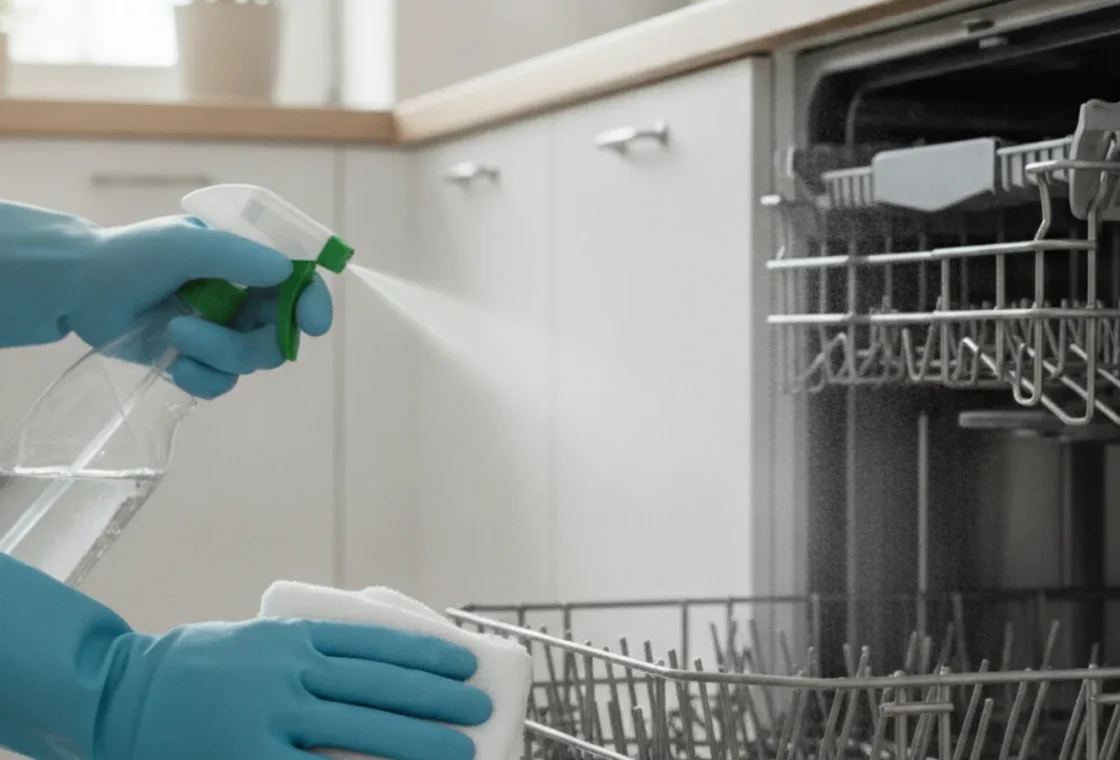
To clean a dishwasher, empty and scrub the filter, run a hot vinegar cycle followed by a baking-soda cycle, and wipe parts that trap gunk like the door gasket, spray arms, and drain area. Do the filter whenever it looks dirty and the full deep clean about once a month.
- Clean the filter first to ensure the vinegar cycle flushes a machine already free of loose debris.
- Always check your owner's manual, as some manufacturers warn against specific methods or materials.
- Do not pour vinegar and baking soda in together; they neutralize each other, so run them as separate cycles.
- The filter is the most important part to clean and often overlooked, catching food particles and debris.
- Avoid wire brushes, steel wool, and scouring pads, as they can permanently damage the filter mesh and stainless tub.
Empty dishwasher
Remove all dishes and racks.
Clean filter
Remove and scrub filter and screen.
Clear drain
Wipe sump and remove debris.
Clean spray arms
Clear jet holes and wipe arms.
Wipe door
Clean gasket and inside door edge.
Run cycles
Run vinegar, then baking soda cycles.
Learning how to clean a dishwasher comes down to three things: emptying and scrubbing the filter, running a hot vinegar cycle followed by a baking-soda cycle, and wiping the parts that trap gunk, such as the door gasket, spray arms, and drain area. Do the filter whenever it looks dirty and the full deep clean about once a month, and your dishes will come out cleaner and the machine will stop smelling. The whole routine takes 15 to 30 minutes of hands-on time, plus a couple of cycles you can walk away from.
Do not pour vinegar and baking soda in together at the same time; they neutralize each other.
Below is a complete, specific walkthrough: what you need, a numbered monthly routine, dedicated sections for the filter, odor, and drain, a comparison of your cleaning-agent options, the mistakes that quietly damage the machine, and a frequency guide. One rule applies throughout: your owner’s manual is the final authority, because a few manufacturers warn against specific methods or materials.
Why does a dishwasher need cleaning at all?
It feels backwards to clean the appliance whose job is cleaning, but a dishwasher only rinses dishes, not itself. Over weeks, food particles, grease, hard-water minerals, and detergent residue collect in three places: the filter at the bottom of the tub, the tiny holes in the spray arms, and the folds of the rubber door gasket. Left alone, that buildup dulls your glassware, leaves grit on plates, and feeds the bacteria and mold responsible for that stale, swampy odor.
Most modern dishwashers use a removable filter rather than the older self-cleaning “hard food disposer” grinders, which means the trapped debris sits there until you remove it by hand. The good news: nearly all of this maintenance uses things you already own, and none of it requires tools beyond a soft brush and a cloth.
What you need before you start
- White vinegar (distilled) and baking soda for the deep-clean cycles
- A dishwasher-safe cup or bowl to hold the vinegar
- A soft brush, sponge, or old toothbrush for the filter, gasket, and spray arms
- A microfiber or soft cloth for wiping the door and edges
- Warm soapy water (a drop of dish soap) for soaking parts
- A toothpick or a piece of thin wire for clearing clogged spray-arm holes
- Optional: citric acid or a commercial dishwasher cleaner for heavy limescale in hard-water homes
Avoid wire brushes, steel wool, and scouring pads entirely. They tear the filter mesh and scratch the stainless tub, and that damage is permanent.
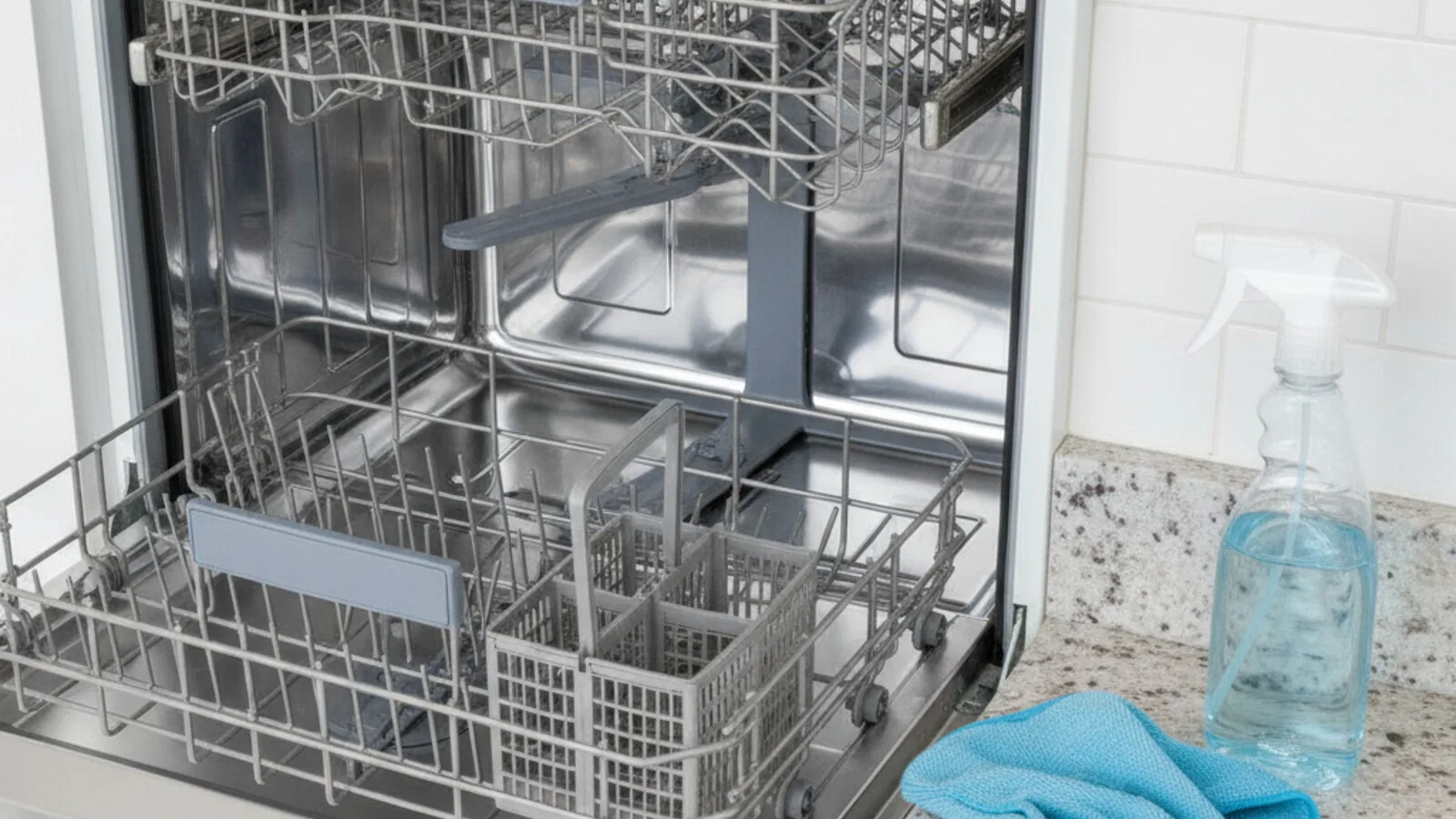
How to clean a dishwasher step by step (the monthly routine)
This is the full deep clean. Run it roughly once a month for a typical household. Work through it in order, because cleaning the filter first means the vinegar cycle flushes a machine that is already free of loose debris.
- Empty the dishwasher completely. Remove all dishes, cutlery baskets, and anything else loose. You want unobstructed access to the floor of the tub.
- Pull out the bottom rack and set it aside so you can reach the filter and the base of the lower spray arm.
- Remove and clean the filter. Most filters twist a quarter turn counterclockwise to unlock, then lift out; a flat secondary screen usually lifts out underneath. Rinse both under warm running water and scrub gently with a soft brush. (Full detail in the filter section below.)
- Clear the drain area. With the filter out, wipe the sump (the recess the filter sits in) and pull away any visible food, glass chips, or labels that have collected there.
- Check and clean the spray arms. Confirm each jet hole is open; clear any blocked ones with a toothpick. Wipe the arms and spin them by hand to make sure they turn freely.
- Wipe the door, edges, and gasket. Run a damp cloth around the rubber seal and along the inside bottom edge of the door, where food and residue love to hide. Use a toothbrush dipped in vinegar for the tight folds.
- Reinstall the filter and twist it until it locks. A loose filter is worse than a dirty one, so make sure it seats fully. Slide the bottom rack back in.
- Run the vinegar cycle. Place a dishwasher-safe cup or bowl holding about one cup of white vinegar on the top rack. Add no detergent. Run the hottest, longest cycle. The vinegar cuts grease, dissolves light mineral film, and deodorizes.
- Run the baking-soda cycle. After the vinegar cycle ends, sprinkle about one cup of baking soda across the floor of the empty tub and run a short hot cycle. This scrubs and freshens, leaving the inside bright.
- Finish by wiping the exterior. Clean the control panel and handle with a soft damp cloth, and buff a stainless front in the direction of the grain.
One safety note that matters: do not pour vinegar and baking soda in together at the same time. They neutralize each other on contact and you lose the benefit of both. Run them as two separate cycles, vinegar first.
How to clean a dishwasher filter
The filter is the single most important part to clean, and the one most people have never touched. It sits at the bottom of the tub, usually in a back corner or around the base of the lower spray arm, and it catches the food that would otherwise redeposit on your dishes.
Removing and rinsing the filter
- Slide out the bottom rack to expose the tub floor.
- Locate the cylindrical upper filter. Most twist a quarter turn to unlock and lift straight out. A few models are held by screws, so check your manual if nothing turns.
- Lift out the flat lower filter or fine screen that often sits beneath it.
- Hold both parts under warm running water and rinse the food debris away.
- Scrub the mesh and crevices gently with a soft brush, sponge, or old toothbrush. For stubborn grease, soak the parts in warm soapy water for a few minutes first.
- Rinse off all soap, then reinstall and twist to lock. Run a short cycle afterward to confirm everything is seated.
Routine filter cleaning needs no chemicals at all, just water and a brush. Save vinegar or dish soap for when it is genuinely greasy. And remember the material: never attack the mesh with a wire brush or scouring pad, because a torn filter stops doing its job.
How to fix a smelly dishwasher
A dishwasher that smells is almost always telling you something is trapped and rotting. The odor comes from bacteria and mold growing on old food and grease, and the growth accelerates when water sits too long because drainage is impaired.
Tackle a smelly dishwasher in this order, stopping when the smell clears:
- Start with the filter. A clogged filter is the most common odor source. Remove and scrub it as described above; this alone fixes many cases.
- Clean the gasket and door edges. Food wedges into the rubber seal and the bottom lip of the door, out of sight. Wipe with a vinegar-dampened cloth and a toothbrush.
- Run the vinegar cycle, which deodorizes the interior and the upper spray arm as it circulates.
- Follow with baking soda for extra freshening and to lift any lingering staleness.
- Check the drain if the smell persists, because standing water there breeds odor (see the next section).
If a foul smell returns within days every single time, or you see standing water in the tub bottom after a cycle, the problem is likely drainage rather than dirt, and that is worth investigating further or calling a technician.
Cleaning Agents Compared
Different cleaning agents offer various benefits for dishwasher maintenance.
| Agent | Purpose | Application | Frequency |
|---|---|---|---|
| White Vinegar | Cuts grease, dissolves light mineral film, deodorizes | 1 cup on top rack, hot cycle | Monthly |
| Baking Soda | Scrubs, freshens, brightens | 1 cup on tub floor, short hot cycle | Monthly |
| Citric Acid | Heavy limescale removal | As directed, for hard water | As needed |
| Commercial Cleaner | Heavy limescale removal | As directed, for hard water | As needed |
How to clean a dishwasher drain
The drain is the low point where water, and anything heavy that escapes the filter, collects. Slow draining or standing water points here rather than to the spray arms. Clearing it is straightforward:
- Remove the filter to expose the drain opening and sump at the bottom of the tub.
- Clear visible debris by hand or with a cloth: food, broken glass, bits of label, and grease.
- Treat with baking soda and vinegar. Sprinkle about a quarter cup of baking soda into the drain, pour in roughly half a cup to a cup of white vinegar, and let it fizz for 10 to 15 minutes.
- Flush it by running the dishwasher on the hottest setting to carry the loosened debris away.
- Reinstall the filter and confirm the machine now drains fully.
If water still pools after this, the clog may sit deeper, in the drain hose or the sump, or in the garbage-disposal connection if your sink shares one. Those are beyond a routine clean and may need disassembly or a professional.
Clearing the spray arms
While you are in the bottom of the machine, give the spray arms attention. Those thin jets of water are what actually blast your dishes clean, and the holes clog with food, minerals, and detergent residue. Lift or unclip the arms if your model allows, poke each blocked hole clear with a toothpick or thin wire about the same diameter as the hole, rinse the arms, and for stubborn buildup soak them in vinegar for up to 30 minutes. Spin them by hand before reinstalling to confirm they turn freely.
How to descale a dishwasher with hard water
If you live in a hard-water area, calcium and magnesium leave a chalky white film, limescale, on the tub walls, heating element, and spray arms. It is cosmetic at first but eventually hurts performance. Learning how to descale a dishwasher is simply a matter of matching the acid to the severity.
- Light film and routine upkeep: the standard vinegar cycle (one cup on the top rack, hot wash, no detergent) handles most mineral haze and doubles as a deodorizer.
- Heavy, crusty scale: citric acid works more aggressively than vinegar. A common approach is to put a few tablespoons of citric acid in the detergent compartment and run a hot cycle with the machine empty; some manufacturers specify a larger dose, so follow your manual.
- Commercial descalers designed for dishwashers are a reliable alternative and come with their own dosing instructions.
Frequency depends entirely on how hard your water is and whether your machine uses dishwasher salt. As a rough guide, descaling three to four times a year suits many hard-water homes, while soft-water households may rarely need it. Check your manual before choosing a product or dose, because some warn against particular acids to protect seals and finishes.
Which cleaning method should you use?
Different problems call for different agents. This table maps the common options to what they are actually good at.
| Method | Best for | How to use it | Keep in mind |
|---|---|---|---|
| White vinegar cycle | Grease, odor, light mineral film, routine deep clean | ~1 cup in a cup on the top rack; hot cycle, no detergent | Gentle and cheap; not strong enough for heavy scale |
| Baking soda cycle | Freshening, mild stains, finishing after vinegar | ~1 cup sprinkled on the tub floor; short hot cycle | Run separately from vinegar, never together |
| Citric acid | Heavy limescale in hard-water homes | A few tablespoons (or per manual) in the detergent cup; hot empty cycle | More aggressive than vinegar; check manual first |
| Warm soapy water + brush | Filter, spray arms, gasket | Soak and scrub by hand | Use a soft brush only; no abrasive pads |
| Commercial dishwasher cleaner | All-in-one deep clean and descale | Follow the product’s label | Convenient; costs more than pantry staples |
Mistakes to avoid
A few well-meaning habits do more harm than good. Steer clear of these:
- Mixing vinegar and baking soda in one cycle. They cancel each other out. Run two separate cycles, vinegar first.
- Using bleach in a stainless-steel tub. Bleach can damage stainless interiors; avoid it unless your manual specifically permits it and your tub is plastic.
- Scrubbing with wire brushes, steel wool, or scouring pads. They shred the filter mesh and scratch the tub.
- Ignoring the filter entirely. It is the number-one cause of poor results and odor, yet the most overlooked part.
- Reinstalling a loose filter. If it does not lock, food bypasses it and lands back on your dishes. Twist until it seats.
- Skipping the manual. Some machines have self-cleaning filters, warn against specific acids, or have unique filter removal; a two-minute check saves a wrong move.
- Over-rinsing dishes before loading. Modern detergents need some food residue to work against, and bone-dry dishes can actually reduce cleaning performance. Scrape, do not pre-wash.
A loose filter is worse than a dirty one, so make sure it seats fully after cleaning.
How often should you clean each part?
Frequency depends on how often you run the machine, how hard your water is, and whether you scrape plates first. Use these as sensible defaults and adjust to your household.
- Door gasket and edges: a quick wipe weekly, or whenever you notice crumbs.
- Filter: monthly for most households; every two weeks if you run the machine daily, have hard water, or rarely scrape; every three to six months if you run it once or twice a week and rinse first.
- Spray arms: check for clogs monthly during the deep clean.
- Deep clean (vinegar + baking soda cycles): monthly.
- Descaling: three to four times a year in hard-water homes; as needed elsewhere.
If your water is soft and you scrape well, you can stretch these intervals. If dishes come out gritty or the machine smells between cleanings, tighten them up.
Your dishwasher cleaning checklist
- Empty the machine and pull the bottom rack
- Remove, rinse, and scrub the filter; reseat it until it locks
- Clear the drain sump of food and debris
- Poke open any clogged spray-arm holes and spin the arms
- Wipe the door gasket, edges, and bottom lip
- Run a hot cycle with one cup of vinegar on the top rack, no detergent
- Run a short hot cycle with one cup of baking soda on the tub floor
- Wipe down the exterior and control panel
- Descale with citric acid or a commercial cleaner if you have hard-water scale
Run through that list once a month and you will keep the machine clean, odor-free, and working the way it did when it was new. The filter and the vinegar cycle do most of the heavy lifting; everything else is quick upkeep. When in doubt about a material, a dose, or a method, let your owner’s manual have the last word.
What works well
- Cuts grease
- dissolves mineral film
- deodorizes
Watch out for
- Neutralizes if mixed
- requires two cycles
Frequently Asked Questions
How do you clean a dishwasher with vinegar?
Place a dishwasher-safe cup holding about one cup of white vinegar on the top rack, add no detergent, and run the hottest, longest cycle. The vinegar cuts grease, dissolves light mineral film, and deodorizes. For extra freshening, follow it with a separate short hot cycle after sprinkling a cup of baking soda on the tub floor. Never run vinegar and baking soda together, as they neutralize each other.
How often should I clean my dishwasher filter?
Monthly works for most households. Clean it every two weeks if you run the machine daily, have hard water, or rarely scrape plates, and every three to six months if you run it only once or twice a week and rinse dishes first. If dishes come out gritty or the machine smells, clean the filter sooner.
Why does my dishwasher smell bad?
Odor usually comes from bacteria and mold feeding on trapped food and grease, most often in a clogged filter, in the folds of the door gasket, or in a slow-draining sump. Clean the filter first, wipe the gasket and door edges, then run a vinegar cycle. If the smell returns quickly or water pools after a cycle, the drain is the likely culprit.
How do I clean a clogged dishwasher drain?
Remove the filter to expose the drain and sump, clear visible food and debris by hand, then sprinkle about a quarter cup of baking soda into the drain, pour in roughly half a cup to a cup of white vinegar, and let it fizz for 10 to 15 minutes. Run the hottest cycle to flush it. If water still pools, the clog may be in the drain hose and need a professional.
How do you descale a dishwasher with hard water?
For light mineral film, the standard vinegar cycle usually does the job. For heavy, crusty limescale, citric acid is more effective: put a few tablespoons in the detergent compartment and run a hot cycle with the machine empty, or use a commercial dishwasher descaler. Descale three to four times a year in hard-water homes, and always check your manual before choosing a dose.