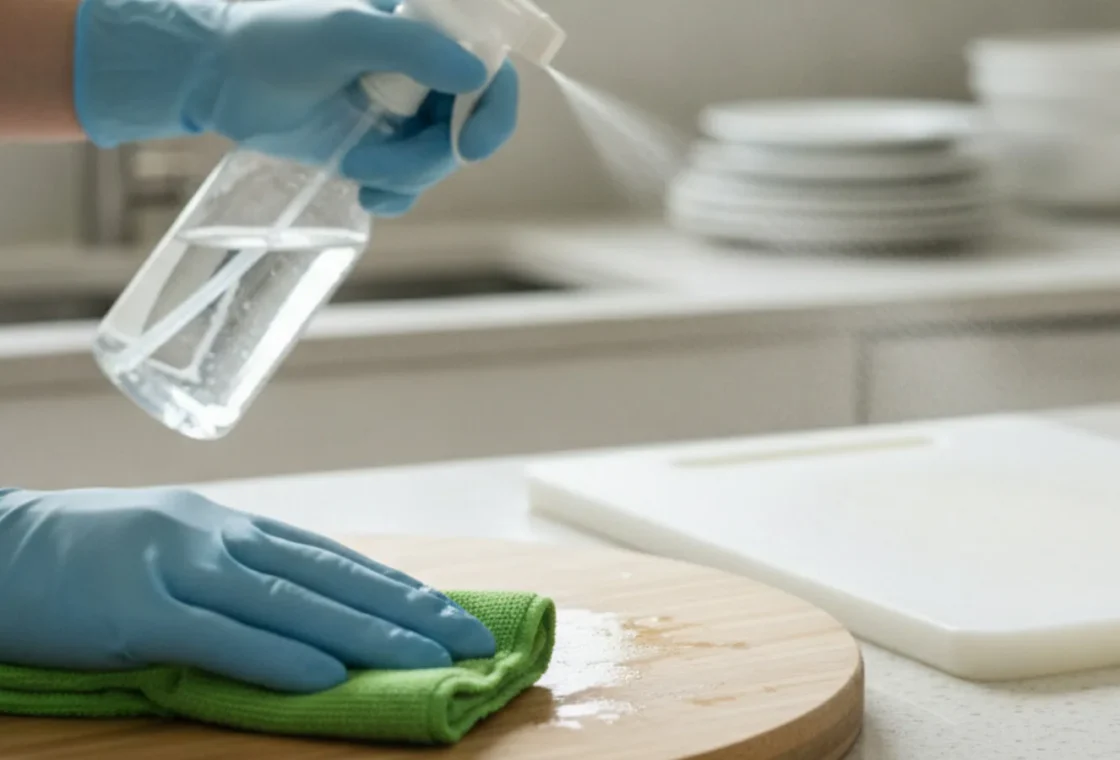
To clean a cutting board, wash it in hot, soapy water right after every use, then sanitize with diluted bleach (or a 3% hydrogen peroxide or vinegar wipe) and dry it on edge so both faces get air. Wood needs quick washing and no soaking; plastic can take the dishwasher and longer bleach contact.
- Wash cutting boards immediately after use to prevent dried-on residue and bacterial growth.
- Always dry cutting boards standing upright to allow air circulation and prevent warping or mildew.
- Never soak wooden cutting boards or put them in a dishwasher, as this can cause cracking and warping.
- Plastic cutting boards benefit from dishwasher cleaning due to high heat and detergent reaching knife grooves.
- Sanitize boards after contact with raw meat, poultry, seafood, or eggs to prevent pathogen transfer.
- Consider using separate cutting boards for raw meats and produce to minimize cross-contamination risk.
Scrape Debris
Clear food scraps into trash or compost.
Wash with Soap
Scrub both faces and edges with hot, soapy water.
Rinse Thoroughly
Rinse under hot running water until no soap film remains.
Sanitize if Needed
Apply a sanitizing solution after raw meat or eggs.
Rinse Sanitizer
Rinse with clean water if using bleach solution.
Dry Standing Upright
Pat dry, then stand on edge for air circulation.
To clean a cutting board, wash it with hot, soapy water right after every use, rinse it, sanitize it with a diluted bleach solution (or a 3% hydrogen peroxide or 5% white vinegar wipe), and dry it standing on edge so air reaches both faces. That routine covers most of what you need, but the details change depending on whether your board is wood or plastic. Knowing how to clean a cutting board the right way for its material is the difference between a surface that lasts a decade and one that warps, cracks, or quietly harbors Salmonella in its knife grooves. This guide walks through washing, disinfecting, stain and odor removal, oiling wood, and knowing when a board is past saving.
Keep a dedicated board, ideally plastic or color-coded, for raw meat and poultry, and a separate board for produce.
Cutting boards sit at the center of the kitchen’s biggest food-safety risk: cross-contamination. The USDA’s Food Safety and Inspection Service treats “Separate” as one of its four core food-safety steps precisely because the board that just held raw chicken can transfer bacteria to a salad if it isn’t handled correctly. So the goal is not just a board that looks clean. It’s a board that is clean, dried, and maintained so it does not become a reservoir for pathogens.
Does cleaning differ for wood versus plastic cutting boards?
Yes, and this is the single most important thing to get right. The two materials behave differently, so a habit that protects a plastic board can destroy a wooden one.
Plastic boards, usually high-density polyethylene (HDPE), are nonporous. Water does not penetrate them, which means they tolerate soaking, long bleach contact, and the dishwasher. The dishwasher is actually plastic’s strongest advantage: the high heat and detergent reach into knife grooves that hand-washing misses.
Wood is porous and alive in a way plastic is not. It swells when it absorbs water and shrinks as it dries, and repeated swings between the two cause the glue joints to fail and the surface to crack or warp. That is why the universal rule for wood is: never soak it and never put it in the dishwasher. Wash it quickly, dry it promptly, and feed it oil periodically so it does not dry out.
There is also a well-known wrinkle in the “which is more sanitary” debate. Research led by the late microbiologist Dr. Dean Cliver at the University of California, Davis, in the 1990s found that bacteria applied to wooden boards largely died off within minutes, with reports of around 99.9% no longer recoverable about three minutes after contamination, while bacteria on plastic survived and could be recovered. Cliver attributed this to wood’s capillary structure drawing bacteria down into the grain, where they die as the wood dries. His team also found that knife-scarred plastic was very difficult to decontaminate by hand, whereas worn wood performed nearly as well as new wood. This research is decades old and tested specific bacteria, wood species, and plastics, so treat it as informative rather than the final word. The practical takeaway holds up: both materials are safe when you wash them promptly, but a heavily grooved plastic board that only ever gets hand-washed is the weakest setup in the kitchen.
What is the step-by-step way to clean a cutting board after each use?
This core routine works for both materials, with the wood-specific cautions noted. Do it immediately after you finish cutting, especially after raw meat, poultry, or seafood, because dried-on residue is harder to remove and gives bacteria time to multiply.
- Scrape off debris. Use a bench scraper or the back of a knife to clear food scraps into the trash or compost before they go down the drain and before they dry onto the surface.
- Wash with hot, soapy water. Use dish soap and the hot side of your tap. Scrub the whole surface, both faces, and the edges with a dish brush or the rough side of a sponge. For wood, keep this brief rather than letting the board sit submerged.
- Rinse thoroughly. Rinse under hot running water until no soap film remains. Residue left behind interferes with any sanitizer you apply next.
- Sanitize if needed. After raw meat, poultry, seafood, or eggs, follow washing with a sanitizing step (the next section covers the bleach ratio and alternatives). For produce-only cutting, a thorough wash is usually enough.
- Rinse off the sanitizer. If you used bleach solution, rinse with clean water afterward so no residue is left on a food-contact surface.
- Dry it standing upright. Pat it with a clean towel or paper towel, then stand the board on its edge in a rack or against a backsplash so air circulates over both faces. Drying flat on a counter traps moisture underneath, which invites warping in wood and mildew in any board. This drying step is not optional for wood, since trapped moisture is the main cause of cracking.
One efficiency habit worth building: keep a dedicated board, ideally plastic or a color-coded one, for raw meat and poultry, and a separate board for produce, bread, and anything ready to eat. That way the board that needs the most aggressive sanitizing is never the same one you use for a tomato an hour later.
How do you disinfect a cutting board properly?
Washing removes most bacteria. Disinfecting is the extra step that matters after raw animal proteins. The most widely cited home standard comes from the USDA’s Food Safety and Inspection Service, and the ratio is easy to remember.
Learning how to disinfect a cutting board with bleach comes down to getting the dilution right. The USDA-referenced sanitizing solution is 1 tablespoon of unscented, liquid chlorine bleach per 1 gallon of water. Flood or wipe the washed surface with the solution, let it stand for a few minutes (roughly two to five) so it has contact time, then rinse with clean water and air-dry. A few important cautions:
- Use plain, unscented chlorine bleach, not scented, “splash-less,” or laundry-additive versions, which are not intended for food-contact sanitizing.
- If you have concentrated bleach, some extension guides suggest a smaller dose, on the order of 2 teaspoons per gallon, since the active chlorine is higher. Check your bottle.
- Do not make the solution stronger thinking it will work better. An overly strong bleach mix can damage wood and leaves more residue to rinse off. More is not safer here.
- Mix the solution fresh. Diluted bleach loses potency over time, so a bottle mixed weeks ago is weaker than you think.
If you prefer not to use bleach, two common alternatives are undiluted 3% hydrogen peroxide and plain 5% white distilled vinegar. Apply one, let it sit briefly, then rinse. A few honest caveats: vinegar reduces some bacteria but does not meet EPA disinfection standards, so it is better thought of as a mild freshening step than a true disinfectant for raw-meat cleanup. Hydrogen peroxide is a stronger antimicrobial but can discolor some surfaces, so test it on a hidden spot first. And never mix vinegar and hydrogen peroxide together in the same bottle or combine either with bleach; use them separately, one after the other if at all. For the specific job of decontaminating after raw poultry, the diluted bleach solution remains the most established home option.
A note on wood and disinfecting: you can absolutely sanitize a wooden board, but do it with a wipe-and-rinse rather than a long soak. Flood the surface, let the solution do its brief work, then rinse and stand the board up to dry rather than leaving it sitting in a puddle.
How do you remove stains and odors from a cutting board?
Beets, turmeric, berries, tomato, raw meat juices, and alliums all leave their mark. For wood especially, the classic and genuinely effective fix is a coarse-salt-and-lemon scrub, and it doubles as a gentle deodorizer.
Sprinkle a generous layer of coarse salt, kosher or sea salt, across the dry board. The larger crystals act as a mild abrasive that lifts surface staining without gouging the wood the way a metal scouring pad would. Cut a lemon in half, and scrub the salt into the surface with the cut side down, squeezing gently so the juice releases as you go. The lemon’s acidity attacks odor-causing compounds while the salt scours. Let the salt-and-lemon paste sit for about five minutes for routine cleaning, or up to about fifteen minutes for stubborn smells like onion, garlic, or fish. Then scrape off the slurry, rinse with warm water, and dry upright. Coarse salt with a little baking soda works similarly if you have no lemon on hand.
Two things to keep in mind. First, the salt-and-lemon scrub is a cleaning and deodorizing method, not a reliable disinfectant, so it does not replace the sanitizing step after raw meat. Second, deeply embedded stains that have soaked into the grain may not come all the way out; surface scrubbing can only reach so far, and a permanent shadow in old wood is cosmetic rather than a safety problem. On plastic, surface stains from things like tomato or turmeric often respond to a paste of baking soda and water, or to a short soak in the diluted bleach solution, though plastic tends to hold dye stains more stubbornly than wood.
Wood vs. Plastic Cutting Boards
This table compares key cleaning and maintenance aspects for wood and plastic cutting boards.
| Feature | Wood | Plastic |
|---|---|---|
| Washing | Brief hand wash | Hand wash or dishwasher |
| Soaking | Never | Tolerates soaking |
| Sanitizing | Bleach, hydrogen peroxide, vinegar wipe | Bleach, hydrogen peroxide, vinegar wipe |
| Drying | Promptly, standing upright | Promptly, standing upright |
| Oiling | Periodically | Not applicable |
How do you oil and condition a wooden cutting board?
Oiling is what keeps a wooden board from drying out, graying, and cracking. The wood is constantly losing moisture to the air and to every wash, and conditioning oil replaces it, filling the pores so water penetrates less and the board stays dimensionally stable. Plastic never needs this; this section is wood only.
Knowing how to oil a cutting board starts with choosing the right oil. Use food-grade mineral oil. It is inexpensive, colorless, flavorless, and, crucially, it does not go rancid. Do not use cooking oils such as olive, vegetable, or canola oil: they are organic and will eventually turn rancid in the wood, leaving a sour smell and sticky film. For extra water resistance, a board cream or “board butter” that blends mineral oil with beeswax (and sometimes carnauba wax) leaves a harder, more water-repellent finish than oil alone.
The method is simple:
- Start with a clean, completely dry board.
- Pour or spread a generous amount of mineral oil over the surface and work it in with a clean cloth or paper towel, going with the grain and covering every face and edge.
- Let it soak in for several hours or overnight so the wood drinks up as much as it can.
- Wipe off any excess that has not absorbed, so the board is not left greasy. If you are using a beeswax cream, buff it to a light sheen after the oil step.
How often? Sources genuinely disagree, because it depends on use and climate, so this is a judgment call rather than a fixed rule. A common starting point is to oil a new board several times in its first couple of weeks, then roughly once a month for a board in regular use, and less often for one that sees light duty. The most reliable signal is the wood itself: if it looks dull, pale, dry, or if water stops beading and instead soaks straight in, it is time to oil. Dry climates and winter heating pull moisture out faster, so you will oil more often then. A board that feels silky and sheds water is well-conditioned.
Wood versus plastic: how does care compare?
Here is a side-by-side of the day-to-day care rules for each material.
| Care factor | Wood (and bamboo) | Plastic (HDPE) |
|---|---|---|
| Hand wash | Yes, quickly with hot soapy water | Yes, hot soapy water |
| Soaking | Never, warps and cracks the wood | Fine, nonporous |
| Dishwasher | No, heat and prolonged water cause cracking and warping | Yes, top rack; reaches into knife grooves |
| Sanitizing | Diluted bleach wipe-and-rinse, then dry upright | Diluted bleach soak or dishwasher |
| Stain/odor fix | Coarse salt + lemon scrub | Baking soda paste or short bleach soak |
| Oiling | Required; food-grade mineral oil periodically | Never needed |
| Drying | Stand on edge, air both faces; critical | Stand on edge or air-dry |
| Best use | Produce, bread, general prep; gentle on knives | Raw meat, poultry, seafood; dishwasher sanitizing |
| Replace when | Cracks, splits, warps, or keeps odor after cleaning | Deep grooves that won’t clean; roughly every 1 to 2 years of heavy use |
What are the biggest mistakes to avoid with cutting boards?
Most ruined boards and most cross-contamination incidents trace back to a short list of avoidable errors.
- Soaking a wooden board or running it through the dishwasher. This is the number one way to crack, split, or warp good wood. Water is the enemy of wood; speed and drying are your friends.
- Leaving a board to dry flat on the counter. Moisture gets trapped underneath, warping wood and growing mildew. Always stand boards on edge.
- Using the same board for raw chicken and then your salad. This is textbook cross-contamination. Keep a dedicated raw-meat board, or wash and sanitize thoroughly in between, never just a quick rinse.
- Skipping the wash before you sanitize. Bleach, peroxide, and vinegar all work poorly on a surface still coated in grease and food residue. Clean first, then disinfect.
- Making the bleach solution extra strong. It does not sanitize better, it leaves more residue, and it can damage wood. Stick to about 1 tablespoon per gallon.
- Oiling wood with olive or vegetable oil. These go rancid and leave a sour, sticky board. Use food-grade mineral oil instead.
- Keeping a deeply grooved board forever. Knife cuts that are too deep to clean trap bacteria permanently. A scarred plastic board that only gets hand-washed is especially risky.
- Letting raw-meat residue sit. Clean promptly. Dried-on protein is harder to remove and buys bacteria time to multiply.
When should you replace a cutting board?
Even a well-maintained board eventually wears out, and at that point cleaning cannot fully protect you anymore. Replace a board when the surface damage outpaces your ability to clean it. The clearest signal is deep knife grooves and scoring that trap food and bacteria where washing and sanitizing cannot reach. Non-regulatory guides often cite grooves deeper than about 1/16 inch, or any splitting, as a practical threshold; treat that as a rule of thumb rather than an official standard.
For wood, also retire a board that has developed cracks or splits, that has warped so it no longer sits flat, or that holds a smell even after a proper cleaning and salt-and-lemon scrub, since lingering odor means something has soaked into the grain for good. For plastic, heavy knife-scarring is the main trigger; consumer sources commonly suggest replacing plastic boards that see frequent raw-meat use roughly every one to two years, sooner if they are badly scored. A cheap plastic board is not worth keeping once it is gouged, because that is exactly the surface the UC Davis research flagged as hardest to decontaminate.
Never soak wooden cutting boards or put them in the dishwasher, as this can cause them to warp, crack, or fail at glue joints.
Quick cutting board care checklist
Keep this routine in mind and your boards will stay safe and last for years:
- Scrape debris, then wash with hot, soapy water after every use.
- Rinse until no soap film remains.
- Sanitize after raw meat, poultry, seafood, or eggs, using 1 tablespoon unscented bleach per gallon of water (or 3% hydrogen peroxide / 5% vinegar as a milder option), then rinse.
- Dry standing on edge so air reaches both faces, never flat.
- Never soak wood or put it in the dishwasher; plastic is dishwasher-safe.
- Remove stains and odors from wood with a coarse salt and lemon scrub.
- Oil wooden boards with food-grade mineral oil whenever they look dry or stop beading water, roughly monthly for heavy use.
- Use separate or color-coded boards for raw meat versus produce and ready-to-eat foods.
- Replace any board with deep, uncleanable grooves, cracks, warping, or stubborn odor.
Clean a cutting board the right way for its material, dry it properly, and keep raw meat on its own surface, and you have closed the biggest everyday gap in home kitchen safety. The whole system is just four habits repeated: wash promptly, sanitize when it counts, dry upright, and, for wood, feed it oil before it gets thirsty.
What works well
- Wood: bacteria die off quickly
- worn wood performs well
Watch out for
- Wood: porous
- swells with water
- never soak
- never dishwasher
Frequently Asked Questions
How do you disinfect a cutting board after raw meat?
Wash with hot soapy water first, then sanitize with a USDA-referenced solution of 1 tablespoon of unscented liquid chlorine bleach per gallon of water. Flood the surface, let it stand a few minutes, rinse with clean water, and dry upright. On wood, wipe and rinse rather than soaking.
Can you put a wooden cutting board in the dishwasher?
No. The prolonged water exposure and high heat make wood swell and then dry out unevenly, which cracks, splits, and warps the board and loosens its glue joints. Hand-wash wood quickly, rinse, and dry it standing on edge. Plastic boards, by contrast, are dishwasher-safe and the dishwasher reaches into knife grooves.
How do you get stains and smells out of a wooden cutting board?
Sprinkle coarse kosher or sea salt over the dry board and scrub with a halved lemon, cut side down, squeezing out juice as you go. Let the paste sit about 5 minutes (up to 15 for strong onion or fish odors), then scrape, rinse, and dry. It cleans and deodorizes but is not a disinfectant, so still sanitize after raw meat.
What oil should you use on a cutting board and how often?
Use food-grade mineral oil, which is food-safe and does not go rancid; avoid olive or vegetable oil, which turn sour. A beeswax board cream adds water resistance. Oil a new board several times early on, then roughly monthly for heavy use, or whenever the wood looks dull or stops beading water. Dry climates and winter call for more.
Is wood or plastic safer, and when should you replace a board?
Both are safe when washed promptly; research from UC Davis found bacteria die off in wood's grain while surviving on plastic, and that scarred plastic is hardest to clean. Replace any board once knife grooves get too deep to clean, or when wood cracks, warps, or keeps an odor. Heavily used plastic meat boards often need replacing every 1 to 2 years.